
Last updated: October 20, 2026
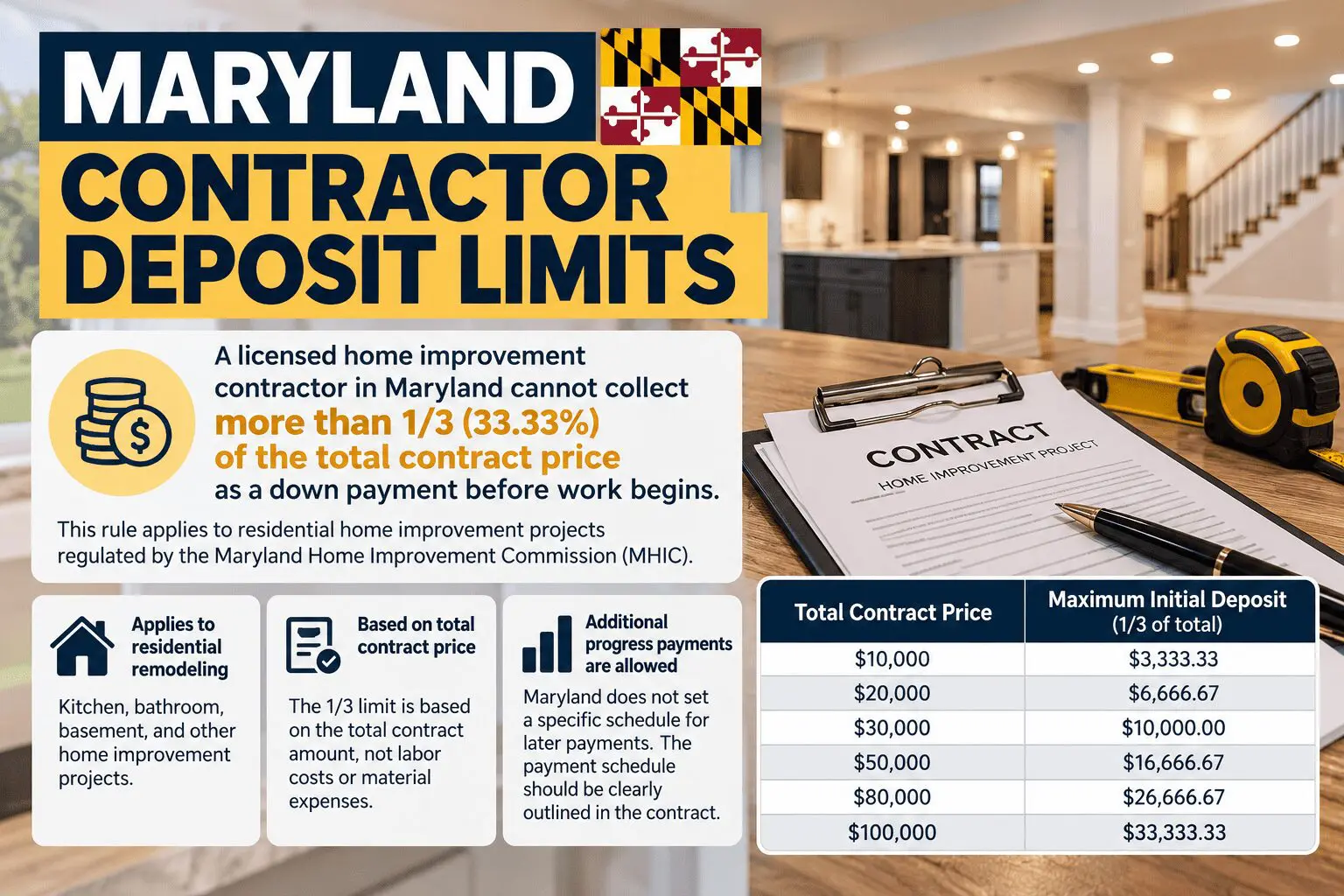
In Maryland, a home improvement contractor cannot legally take more than one-third of the contract price as a deposit, and cannot take any money at all before the contract is signed. That is not a guideline or an industry norm. It is state law, and it applies to us the same as it applies to everyone else.
Most homeowners do not know it, which is why some contractors still ask for 50 percent up front. This page explains what Maryland law actually requires, what a legitimate payment schedule looks like, and what protection you have if a job goes wrong.
This is general information, not legal advice. We are a licensed remodeling contractor, not a law firm. The rules below come from the Maryland Home Improvement Law and the Maryland Department of Labor, and they change from time to time. For advice about your own contract or dispute, speak to a Maryland attorney or contact the Maryland Home Improvement Commission directly.
What the deposit law actually says
Two rules sit in the same short section of the Maryland Business Regulation Article, § 8-617:
No payment before signing. A person may not demand or receive any payment for a home improvement before the home improvement contract is signed. Not a holding fee, not a scheduling deposit, not a “lock in this price today” payment.
One-third maximum deposit. A person may not receive a deposit of more than one-third of the home improvement contract price, before or at the time the contract is signed.
So on a $30,000 kitchen, the most a contractor can legally collect at signing is $10,000. On a $12,000 bathroom, $4,000. After that initial deposit, the payment terms are negotiable — the Department of Labor says so explicitly — but the first payment is capped no matter what the contract says.
A contract clause asking for more does not make it lawful. The cap is on the contractor’s conduct, not on what the paperwork claims.
Why “I need 50 percent for materials” is not a real answer
It is the most common pushback, and it deserves a straight response: material costs are the contractor’s problem to finance, not a reason to exceed a legal limit.
There are genuine cases where money has to go out early. Custom cabinets, a made-to-order vanity, specialty tile on a long lead time — suppliers often want payment before they start a run. That is real. But the correct way to handle it is a progress payment tied to the delivery of those materials, not a bigger deposit. The money moves when the cabinets arrive at your house or at the shop, and you can see what you paid for.
If a contractor cannot float the gap between a one-third deposit and the first material delivery on a mid-sized remodel, that tells you something about the state of their business. On a large project, structuring the draws to fund orders as they are placed solves it without anybody breaking the law.
What a normal Maryland payment schedule looks like
There is no legally mandated schedule beyond the deposit cap, so this is how we structure ours. Treat it as a reference point for comparing bids, not a rule.
| Stage | Share of contract | Triggered by |
|---|---|---|
| Deposit at signing | Up to 1/3, often less | Signed contract, before any work |
| Demolition and rough-in complete | 25% – 30% | Plumbing, electrical and framing roughed in |
| Rough inspections passed | 15% – 20% | County sign-off on the rough work |
| Materials delivered or set | 10% – 20% | Cabinets, tile or fixtures on site |
| Final payment | 10% – 15% | Punch list done, final inspection passed |
Two things matter more than the exact percentages. Every payment should be tied to something you can verify — an inspection passed, a delivery made, a stage complete — rather than to a date on a calendar. And hold a meaningful final payment. A 2 percent retainage gives nobody any incentive to come back and finish the punch list.
What your contract has to contain
Maryland does not leave this to the contractor’s discretion. A home improvement contract must be in writing, legible, and signed by both parties, and you must receive a signed copy before work starts. It must include all of the following.
| Required in the contract | What to look for |
|---|---|
| Contractor name, address and MHIC licence number | A number you can look up, not just a company name |
| Salesperson’s name and licence number | Required if a salesperson sold you the job |
| Description of the work and the materials | Named products, not “owner’s choice of tile” |
| Approximate start and substantial completion dates | Actual dates, not “to be scheduled” |
| The agreed price, clearly stated | One number, with any allowances identified |
| MHIC notice with phone number and website | Plus the statement that every contractor must be licensed |
| Guaranty Fund notice | Tells you the fund exists before you sign |
| Performance bond notice | Required disclosure |
| Mortgage or lien notice | Only if payment is secured against your home |
| Arbitration clause details, with initials | If the contract forces arbitration, you initial it knowingly |
| Door-to-Door Sales Act disclosures | If that Act applies to how the sale happened |
| Each document incorporated by reference | Plans, specs and allowances listed by name |
A one-page quote with a total and a signature line is not a compliant Maryland home improvement contract. If that is what you are handed, ask for the real thing. Our guide to questions to ask a remodeling contractor covers what else to ask before you sign.
Two different cancellation clocks
Homeowners often believe there is a blanket three-day right to cancel any contract. There is not. In Maryland two specific rights apply to home improvement work, and which one you get depends on how the deal was made.
If payment is secured by a mortgage or lien on your home, the contract must state that you have the right to rescind within three business days after you sign. You exercise it by notifying the contractor in writing.
If the Door-to-Door Sales Act applies — broadly, where the sale happened at your home rather than at a place of business — you may cancel before midnight of the fifth business day, or midnight of the seventh day if you are at least 65. A separate Notice of Cancellation form has to be attached to the contract.
If neither applies, there may be no statutory cooling-off period at all, and you are governed by whatever the contract says. That is a reason to read it before signing rather than after.
The Guaranty Fund, and why the licence number is the whole game
Maryland runs a Home Improvement Guaranty Fund, paid for by assessments on licensed contractors when they get and renew their licences. It compensates homeowners for actual monetary losses caused by poor workmanship or a failure to perform the contract.
The numbers, per the Department of Labor: you can recover up to the amount you actually paid the contractor, capped at $30,000. If total claims against a single contractor exceed $250,000, awards are pro-rated across claimants.
Here is the part that matters most: the Fund applies only to work done by licensed contractors. Hire an unlicensed contractor and that protection does not exist, whatever the price advantage was. Only MHIC-licensed contractors may contract with homeowners for home improvement work in the first place.
This is the real cost of the cash-only, no-paperwork bid. It is not just the absence of a warranty. It is the removal of a $30,000 backstop the state would otherwise have given you for free.
Check the licence yourself in two minutes
Do not take a number printed on an estimate at face value. Look it up on the Maryland Department of Labor’s licence search for the Maryland Home Improvement Commission and confirm four things:
That the licence exists and is active, not expired. That the name on the licence matches the name on your contract — a licence held by a different entity than the one you are signing with is a problem. Whether there is any complaint or disciplinary history. And that the licence type covers the work; a salesperson’s licence is not a contractor’s licence.
Ours is MHIC #159517, and we would rather you checked it than took our word for it. Check every contractor you are considering, including the one you already decided on.
Liens: the paperwork that protects you from someone else’s unpaid bill
A mechanic’s lien lets an unpaid subcontractor or supplier make a claim against your property even though your agreement was with the general contractor. Two deadlines frame it in Maryland: a subcontractor generally must give the owner written notice of intent within 120 days of last supplying labour or materials, and must file a petition to establish the lien within 180 days.
Maryland law does give homeowners a payment defence in certain single-family situations, but it is narrow and turns on exactly when you paid relative to when notice arrived. Do not plan around it. Instead, do the simple practical thing: ask for signed lien waivers or releases from subs and suppliers with each progress payment, and keep them. On a project where subs and material suppliers are involved, that habit is worth more than any clause in the contract.
If a lien is filed against your home, that is the point to call a Maryland construction attorney rather than to read articles.
Nine things that should stop you signing
A deposit over one-third. It is unlawful, and someone willing to break a rule this clear will break others.
Any request for money before the contract is signed. Same answer.
No MHIC licence number on the contract. Required. Its absence is disqualifying.
Cash only, or payment to an individual rather than the company. You are being set up to have no recourse.
No start or completion dates. Required, and the most common omission we see in competitors’ paperwork.
Pressure to sign today. A legitimate price survives until tomorrow.
“We don’t need a permit for this.” Sometimes true, often not, and the risk lands on you as the owner. See our guide to remodeling permits in Montgomery County, and what unpermitted work costs when you sell.
A bid far below the others with no explanation. Usually a scope that is missing items, which surfaces later as change orders.
No proof of insurance. Ask for a certificate of liability and workers’ compensation naming you, sent by the insurer rather than forwarded by the contractor.
Maryland contractor deposit and contract FAQ
How much deposit can a contractor legally ask for in Maryland?
No more than one-third of the contract price, and nothing at all before the contract is signed. That comes from Business Regulation § 8-617 and is confirmed by the Maryland Department of Labor.
Is the one-third deposit limit per project or per payment?
It applies to the deposit — the money taken before or at signing. Payments after that are negotiable and are normally tied to stages of work, so a later draw can take you past one-third of the total paid.
What if the contract I signed says 50 percent down?
The limit restricts what a contractor may receive, regardless of the clause. If you have already paid more, you can raise it with the contractor and, if that fails, file a complaint with the Maryland Home Improvement Commission. For your own situation, get advice from a Maryland attorney.
Does the one-third cap apply to custom cabinets and special orders?
Yes. The cap has no materials exception. A legitimate contractor handles long-lead orders with a progress payment on delivery instead of a larger deposit.
Can I get my deposit back if I cancel?
It depends on whether a cancellation right applies — three business days where payment is secured against your home, five business days under the Door-to-Door Sales Act, seven days if you are 65 or older — and on what your contract says. Outside those windows, the contract governs.
What does the Guaranty Fund actually pay?
Up to what you paid the contractor, capped at $30,000 per claim, for actual losses from a licensed contractor’s poor workmanship or failure to perform. Awards are pro-rated if claims against one contractor exceed $250,000. Unlicensed work is not covered.
Does any of this apply in Washington, DC?
No. The Maryland Home Improvement Law and the Guaranty Fund are Maryland programmes. DC has its own licensing and consumer protection rules, so a Maryland MHIC licence is not a substitute for DC credentials on a DC project.
Related reading
- Questions to Ask a Remodeling Contractor in Maryland
- Home Remodeling Permits in Montgomery County, MD
- Bathroom Remodeling Cost in Montgomery County
- Kitchen Remodeling Cost in Montgomery County
- Basement Finishing Cost in Montgomery County
- What Not to Do in a Kitchen Remodel
Working with a licensed contractor in Montgomery County and Washington, DC
We take a deposit at or under the legal third, tie every later payment to a stage you can see or an inspection you can verify, and put the licence number, the dates, the price and the named materials in the contract before anyone picks up a tool. Our estimates break the scope into line items, so when you compare our price against another bid you are comparing the same work rather than two totals. See what we do in bathrooms, kitchens and basements, or the areas we serve.