
Last updated: August 8, 2026
It’s one of the most common questions we get from Montgomery County homeowners finishing a lower level: can we put a bathroom down here? The answer is almost always yes — and adding a bathroom to a basement is one of the highest-impact upgrades you can make, turning a basement from “extra space” into a guest suite, in-law setup, or rental-ready level. This guide covers real 2026 costs in Maryland, the plumbing options, permits, and what to expect.
- Can You Add a Bathroom to Your Basement?
- Cost to Add a Basement Bathroom in Maryland (2026)
- Plumbing Options: Rough-In, Breaking Concrete, or Up-Flush
- Permits & Code in Montgomery County
- How Long It Takes
- Toilet, Shower & Laundry Considerations
- Is a Basement Bathroom Worth It?
- Frequently Asked Questions
Can You Add a Bathroom to Your Basement?
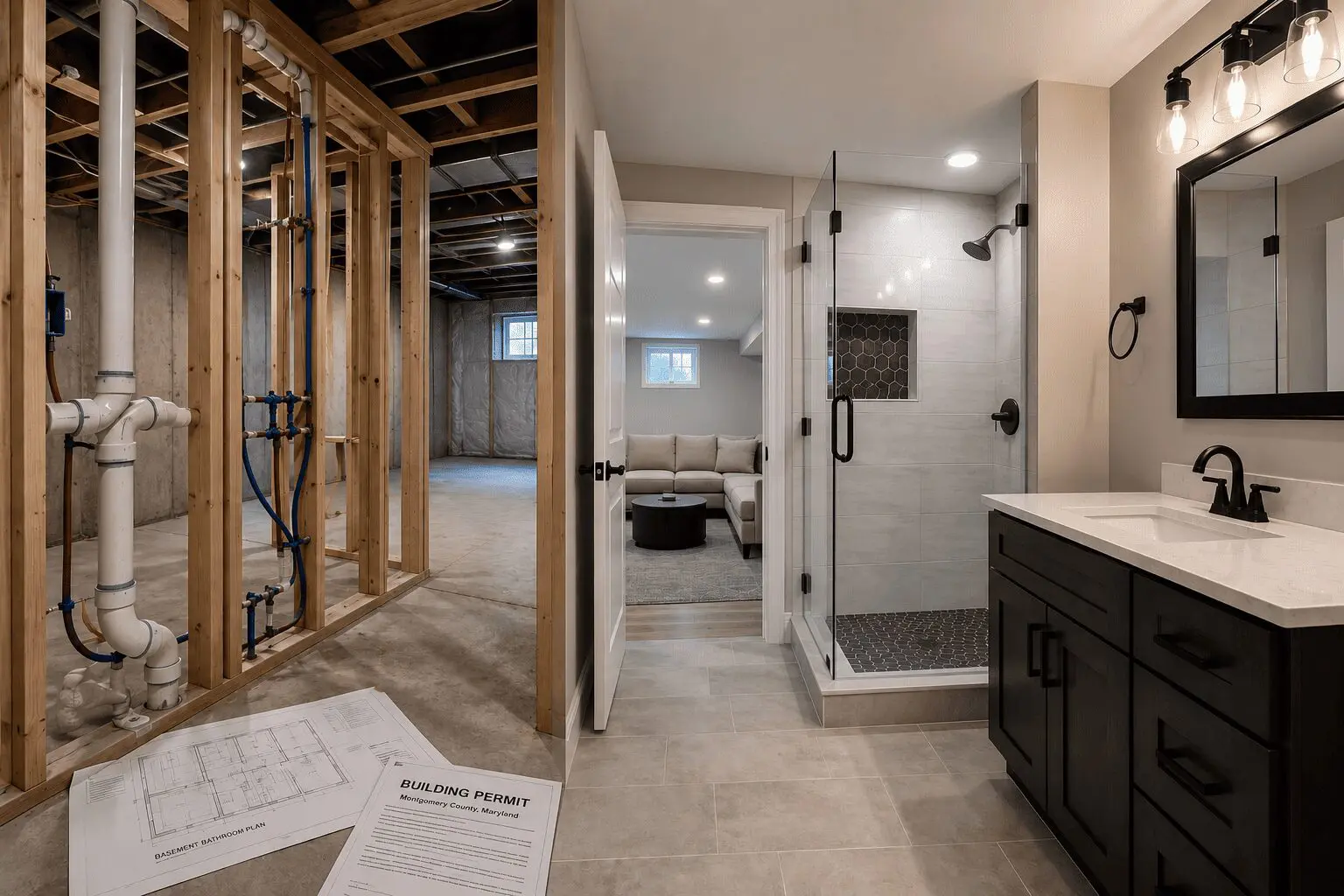
In nearly every Maryland home, yes. The three things that determine how easy (and how expensive) it will be are: where your main sewer line exits the house, whether the builder left a plumbing rough-in in the slab, and your ceiling height in the area you want to use. Many Montgomery County homes built after the 1980s already have a rough-in — capped pipes sticking out of the concrete floor, usually in an unfinished corner. If you have one, you’re halfway there. If not, there are still two reliable paths (covered below).
Cost to Add a Basement Bathroom in Maryland (2026)
Here’s what basement bathroom projects typically run in Montgomery County in 2026, installed by a licensed contractor:
| Project | With Existing Rough-In | No Rough-In |
|---|---|---|
| Half bath (toilet + sink) | $8,000–$15,000 | $13,000–$22,000 |
| Full bath (with shower) | $15,000–$25,000 | $22,000–$35,000 |
| Luxury full bath | $25,000–$40,000 | $35,000–$55,000+ |
The biggest drivers of your total basement bathroom remodel cost are breaking and re-pouring concrete for new drain lines, whether a sewage ejector pump is needed (when the bathroom sits below the sewer line), and finish level. Adding a basement bathroom as part of a full basement finish is meaningfully cheaper than doing it as a standalone project later — the framing, electrical, and drywall crews are already there. See our full basement finishing cost guide for whole-basement numbers, or get an instant estimate with our free remodeling cost calculator.
Plumbing Options: Rough-In, Breaking Concrete, or Up-Flush
Existing rough-in: the best case. Drain and vent lines are already under the slab — we uncap them, set the fixtures, and most of the cost goes to finishes instead of concrete work.
Breaking the slab: the standard approach when there’s no rough-in and gravity drainage is possible. We saw-cut the concrete, trench new drain lines to the main stack, and re-pour. It sounds dramatic, but for an experienced crew it’s routine — typically 2–3 days of the schedule.
Up-flush / macerating systems: when the bathroom would sit below the sewer line or breaking concrete doesn’t make sense, a macerating toilet or a sewage ejector basin pumps waste up to the main line. Modern systems are reliable and code-approved; they add roughly $2,000–$5,000 versus gravity drainage and are the reason almost any basement can have a bathroom.
Permits & Code in Montgomery County
Yes — you need permits. A basement bathroom involves plumbing, electrical, and usually framing, each of which requires a permit and inspection in Montgomery County. Key code points: bathrooms need proper ventilation (an exhaust fan ducted outside), GFCI-protected outlets, and adequate ceiling height. If the bathroom is part of creating a bedroom or living space, egress window requirements may also come into play. A licensed contractor pulls the permits and schedules inspections for you — read more in our guide to remodeling permits in Montgomery County. Unpermitted bathrooms are a classic problem at resale, so this is not the place to cut corners.
How Long Does It Take?
As a standalone project, a basement bathroom typically takes 2–4 weeks: a few days of concrete/plumbing work, then framing, electrical, inspections, drywall, tile, and fixtures. As part of a full basement finish, the bathroom rides along with the overall 6–10 week schedule. If moisture is a concern in your basement, address it first — our basement waterproofing guide explains the options and costs.
Toilet, Shower & Laundry Considerations
Toilet placement is driven by the drain location — moving a toilet far from the stack adds cost quickly, so we design the layout around the plumbing, not against it. Showers in basements work beautifully with curbless or low-curb designs, and a properly sloped pan handles drainage even on a slab. Many homeowners pair the new bathroom with a basement laundry area — since the water supply and drainage are already being run, adding washer/dryer hookups alongside the bath is one of the cheapest upgrades you’ll ever buy, often just $1,500–$3,000 more when done at the same time.
Is a Basement Bathroom Worth It?
For most Maryland homes, strongly yes. A finished basement with a bathroom functions as a guest suite, teen hangout, home office, or in-law space — a basement without one always sends people upstairs. Appraisers and buyers treat a below-grade full bath as a real bathroom, and it’s often the difference between a basement that helps sell the house and one that’s just storage. Our breakdown of finished basement ROI in Maryland covers the numbers in detail.
Think2Remodel is a licensed Maryland contractor (MHIC #159517) serving Montgomery County and Washington, DC. We handle basement bathrooms end to end — design, permits, plumbing, and finishes. Contact us for a free in-home estimate.
Frequently Asked Questions
How much does it cost to add a bathroom to a basement?
In Montgomery County in 2026, a half bath typically runs $8,000–$22,000 and a full bath $15,000–$35,000, depending mostly on whether a plumbing rough-in already exists. Luxury finishes can push beyond $50,000.
Can you add a bathroom to a basement without breaking concrete?
Yes. Up-flush (macerating) toilets and sewage ejector systems pump waste up to the main sewer line, so no slab trenching is required. They add roughly $2,000–$5,000 versus gravity drainage.
Do I need a permit to add a basement bathroom in Maryland?
Yes. Plumbing, electrical, and building permits with inspections are required in Montgomery County. A licensed contractor handles the permit process for you.
How long does it take to install a basement bathroom?
Usually 2–4 weeks as a standalone project, including inspections. As part of a full basement finish it folds into the larger 6–10 week schedule.
Does a basement bathroom add value to a home?
Yes — buyers and appraisers count a below-grade full bath as a real bathroom, and it dramatically increases how usable the finished basement is as living space.
Related reading: Costing the whole basement? See our guide to basement finishing costs in Montgomery County.